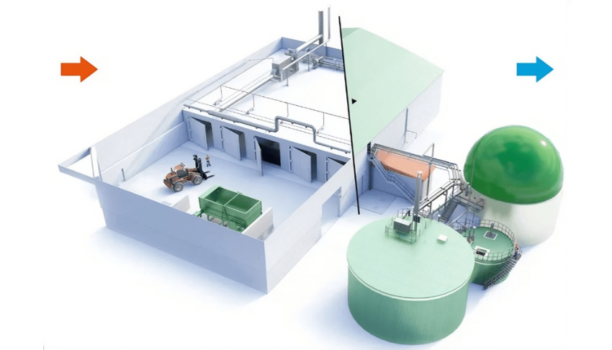
In biogas production units, filtration plays a decisive role in the overall performance of the process. With saturated humidity, the presence of aerosols and fine particles, the constraints are numerous and often underestimated.
In this article, we provide a practical overview of the challenges associated with biogas filtration, with a particular focus on coalescence, a key technology for providing long-term protection for your equipment.
Biogas and contaminants: understanding filtration challenges
At the outlet of a digester or landfill site, biogas is 100% saturated with moisture. Compression stages promote the formation of aerosols, mainly resulting from condensation.
These contaminants fall into three main categories:
- fine aerosols (0.05 to 3 microns), which are predominant and invisible,
- droplets resulting from mechanical phenomena (10 to 200 microns),
- larger liquid carryover.
Aerosols account for more than 50% of the contamination and represent a major risk for membranes and sensitive equipment.
Why filtration alone is not enough for biogas treatment
Conventional filtration is effective at retaining solid particles, but it quickly reaches its limits when dealing with the finest aerosols.
These aerosols pass through conventional filters and can damage:
- compressors,
- activated carbon beds,
- PSA membranes.
To effectively remove these contaminants, a coalescence stage must be integrated into the process.
Aerosol coalescence: principle and operation
Coalescence is based on a simple principle: transforming microdroplets into droplets large enough to be drained away.
The process takes place in three stages:
- Interception and impaction of aerosols within the filter media,
- Droplet merging (coalescence),
- Gravity drainage of the resulting liquids.
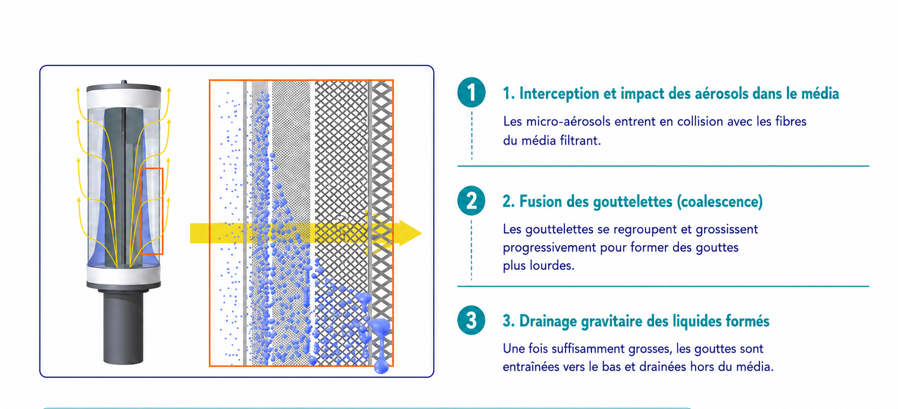
Unlike conventional filtration, the flow direction through the media is reversed, promoting droplet growth.
Filtration and coalescence: an optimal strategy for biogas
Combining filtration and coalescence provides the most robust solution for securing a biogas process.
It makes it possible to:
- protect upstream compressors,
- maintain the efficiency of activated carbon,
- prevent membrane fouling.
A critical consideration concerns activated carbon: it must remain dedicated to the adsorption of volatile compounds. Any liquid or particulate fouling drastically reduces its performance.
Sizing a coalescer: key performance parameters
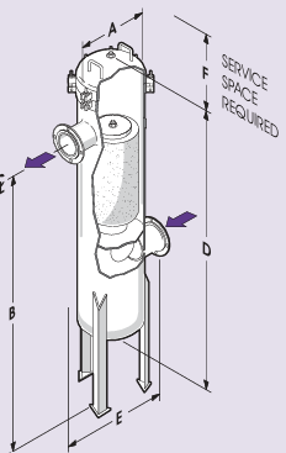
An efficient coalescer relies on three essential elements:
- The filter media:
It must be hydrophobic and oleophobic to prevent liquid re-entrainment. - Flow velocity:
Laminar flow is essential to ensure effective coalescence. - Overall sizing:
It must be adapted to the process conditions (flow rate, pressure and gas composition).
An optimised design can achieve efficiencies of more than 99.98% for fine aerosols.
Biogas filtration: operational and economic benefits
Integrating an appropriate filtration system delivers significant benefits:
- membrane service life increased by a factor of 3 to 5,
- reduced unplanned downtime,
- optimised activated carbon service life,
- improved biomethane quality,
- reduced maintenance costs.
Maintenance operations also become simpler and faster, particularly thanks to cartridge replacement.
Best practices for effective biogas filtration
To ensure the performance of your filtration system, several best practices should be followed:
- accurately analyse the composition of the biogas,
- correctly position the equipment within the process,
- monitor differential pressure (ΔP),
- adapt maintenance cycles.
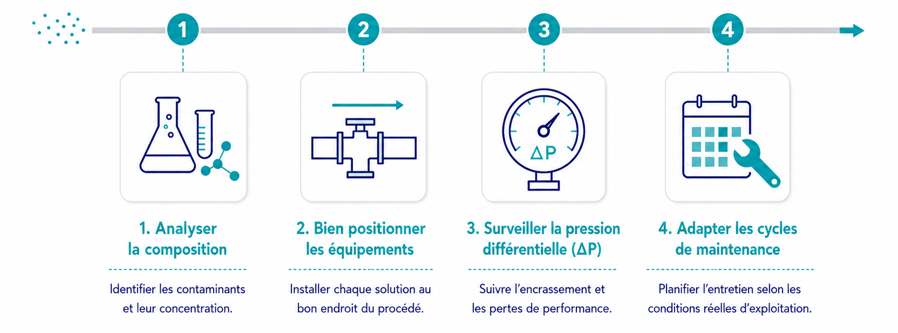
A comprehensive approach to the entire process is essential to maximise performance.
Conclusion: filtration as a performance driver for biogas plants
Biogas filtration is not simply a matter of installing a filter. It requires a thorough understanding of the physical phenomena involved and the coherent integration of separation technologies.
By combining filtration and coalescence, the reliability, performance and profitability of biogas installations can be significantly improved.

Contact a filtration expert
We are at your service
Our experts place their knowledge and expertise at your disposal for liquid filtration, air and gas filtration, decontamination, and separation technologies.